quarta-feira, 25 de setembro de 2019

Maximus the Confessor's "Letter to Marinus" (Vladimir Lossky)

Father Venance Grumel, in the article he devotes to Maximus in the Dictionnaire de Theologie Catholique declares that Maximus, in his letter to Marinus, justifies the Roman formula! Now, Maximus shows that it is only a matter of economy. In the ninth century, at the time certain westerners already professed unacceptable views, Anastasius the Librarian, a high dignitary of the Roman Curia and a great Hellenist scholar in a letter addressed in Latin to John the Deacon, speaks of this letter of Maximus to Marinus: "We have translated a passage from the letter of Saint Maximus to Marinus, in which he says that the Greeks were wrong in accusing us, since we do not think that the Son is the cause of the Spirit, but we only want to show the unity of substance: as the Spirit proceeds from the Father, so likewise can one say that He proceeds from the Son, but understanding thereby the sending (missionem) of the Holy Spirit." "And thus,"Anastasius concluded, "Maximus has shown in what sense the Spirit proceeds and in what sense he does not proceed from the Son, and he has avoided the difficulty due to a reciprocal ignorance of the languages." The result is that for Anastasius the attacks by the Greek theologians make no sense. For him, the Father is the sole cause; the Filioque defines a mission. In Migne's Patrology, the editor of the letter of Anastasius (that precedes the letter of Maximus to Marinus) introduces here a little note where he signals that one should read emissionem where the text indicates missionem - if not, one would be in agreement with the schismatic Greeks!


From the book "Orthodox Dogmatic Theology: Creation, God's Image in Man, & the Redeeming Work of the Trinity" by Vladimir Lossky 

quarta-feira, 11 de setembro de 2019

Notes on Created and Uncreated Grace

According to St. Basil (both in his letters and in his Contra Eunomium) it is impossible to know anything about the divine essence (ousia). He insists - against the teaching of Eunomius, who held that knowledge of the divine essence (ousia) was possible - that knowledge of God comes only by participation in His energies.


“We say that we know our God from His operations (energeiai), but do not undertake to approach near to His essence (ousia). His operations (energeiai) come down to us, but His essence (ousia) remains beyond our reach.” - St. Basil the Great


The essence / energy distinction also protects God’s hetero-essentiality in relation to creation, while allowing for a real energetic participation in His divinity by creatures. To put it another way, God is essentially (and wholly) transcendent, while He is simultaneously energetically (and wholly) immanent.

In Scholastic theology "created" grace is ". . . a quality, a light that enables the soul to receive worthily the indwelling of the three divine Persons," [Charles Journet, The Meaning of Grace, page 19], but in Eastern theology this Light (or "quality") is the very uncreated energy of God. In other words, the effects of grace in man in Western theology are seen as "created"; while in Eastern theology these "effects" are seen as a participation in the uncreated God Himself as energy. In fact St. Gregory Palamas points out that, ". . . the divine Maximos has not only taught that it [i.e., the gift of theosis] is enhypostatic*, but also that it is unoriginate (not only uncreated), indescribable and supratemporal. Those who attain it become thereby uncreated, unoriginate, and indescribable, although in their own nature, they derive from nothingness." [St. Gregory Palamas, The Triads, page 86] Thus, in Eastern theology there is no such thing as "created" grace, nor can there ever be such a thing, because grace is God Himself.

Now the differences between East and West on the issue of grace were highlighted by Fr. Joseph Gill, S.J., in his book on the Western Council of Florence, for as he pointed out in his treatment of the topic of grace, the doctrinal differences between the two sides became particularly evident during the discussions between John Montenero, O.P., and St. Mark of Ephesus in the fifth session of the Council on March 14, because during a very heated exchange on the issue of the effects flowing from power of grace, Fr. Montenero ". . . pressed Mark [of Ephesus] as to whether the gifts of the Spirit were different from the Spirit Himself," which is what the Latins believed, or if the gifts flowing from the Spirit were the Spirit Himself, which is what the Byzantine Church holds. St. Mark of course rejected the Latin position and this caused further heated exchanges, culminating in an intervention by the Emperor ordering that the subject be dropped. Now even though the exchange ended abruptly (i.e., because of the Emperor's interference), it did show that the two sides disagree on the nature of grace, and in fact as Fr. Gill went on to say, it was this line of debate that brought up the ". . . Palamitic question of the divine energies, which Mark with most Greeks held to be really distinct from the divine essence, an opinion that the Latins both then and now consider wrong." [Fr. Joseph Gill, The Council of Florence, pages 205-206] Thus, it is clear that East and West understand the nature of grace differently, because for the West the effects of the Spirit within man are "created" realities, i.e., they are a "created" grace; while for the East the effects are a true participation in the uncreated divine energy, which is God Himself as He exists outside of His ineffable essence.

*Enhypostatic is used as a contrast to the terms authypostatic and anhypostatic. That which is enhypostatic is not self-subsisting (authypostatic), nor is it merely transitory or illusory (anhypostatic), but is instead a real quality inhering in a hypostasis.

Nature of Sanctifying Grace. What is sanctifying grace? It has been called the “masterpiece of God’s handicraft in this world … far more glorious than anything we can behold in the heavens above us or on the earth at our feet.” Is it just God’s favor toward us, as Luther wanted? No, it is much more. Is it God’s life or nature or God’s love, as some have called it? No, for God’s life and love and nature are uncreated, are God Himself. Sanctifying grace is not God, it is not the Holy Spirit, it is not just God’s favor. It is something created, given to us by God out of love and mercy, which gives us a created likeness of God’s nature and life. It is a supernatural gift infused into our souls by God, a positive reality, spiritual, supernatural, and invisible. 
Divine Quality. According to St. Thomas, sanctifying grace “is neither a substance nor a substantial form, but an accidental form, a permanent quality placed by God in the very essence of the soul, which causes it to participate by means of a certain likeness in the divine nature” (1-2q110aa.2-4). No wonder, then that the Roman Catechism calls it a “divine quality.”

The definitions given by Fr. Hardon in connection with sanctifying grace are completely foreign, and even inimical, to the teaching of the Byzantine tradition on grace. There is no such thing as “created grace,” nor is there a “created supernatural,” etc., and in fact the whole approach taken by the West since the time of the Scholastics is contrary to the teachings of the Eastern Church Fathers.

Fr. Hardon is saying that man receives a “created” quality, i.e., something other than God Himself that makes us only like God in a created manner. This take on grace is simply unacceptable to Eastern Christians.

Eastern Christianity teaches that grace, both in itself and in its reception, is uncreated, and has the effect of making the recipient uncreated energetically. There are no “created” acts of grace, and so when a man loves as God loves, he loves in an uncreated way.

Once again, for the West - according to Fr. Hardon (and the Scholastics he accepts as normative) - there is a “created supernatural,” but there is no such thing in reality; instead, there is only God and creation, for there is nothing that exists in between the Creator and His creation. That being said, it is clear that man does not receive a “created” sanctifying grace, and in fact such a thing (i.e., a created grace or quality) could never divinize a man; and that is why in Eastern theology it is said that man receives God Himself as energy, and that gift of God’s energy is what makes man eternal and uncreated by grace.

Roman Catholic: There is the dogma de fide that “By reason of His endowment with the fullness of created habitual grace, Christ’s soul is also accidentally holy.”
I reject that “dogma” as you call it, because Christ’s soul is holy, not because it has received some alien “created habitual grace,” but because His human soul as been infused (and even permeated perichoretically) with divine energy, and so it has been divinized in reality and not in mere appearance by a some kind of non-existent “created” quality.

It is an ancient axiom of the Eastern Fathers that only the uncreated can divinize the created. So there can be no “created grace,” because such a thing could never elevate man into the very life of the Triune God. To put it another way, man becomes God in God in the Eastern doctrinal tradition; while in the Western tradition (at least since the time of the Scholastics) man becomes divine through a “created grace” that gives him a mere likeness to God in a created fashion. The Western teaching, at least from an Eastern perspective, is very similar to Arianism.
Roman Catholic: The Holy Spirit consists of the created accidental grace and the uncreated substantial grace.

I find this notion utterly repulsive. The Holy Spirit is uncreated, both as to His hypostasis and when speaking of the energies that flow from Him. Grace is not an accident (in the Aristotelian sense); instead, it is God Himself personally (enhypostatically) as He comes down to us. There can be no such thing as “created grace” in the doctrine of the Eastern Churches. The idea of there being “created grace” is as nonsensical as saying there is a “created God.”
Roman Catholic: East and west can agree that God does (actus purus) aside from what he is the ineffable, and the grace of the Holy Spirit is uncreated.
I do not believe that God is “actus purus”; instead, I hold that God is essence, energy, and a triad of divine hypostaseis. Quite frankly, God is beyond the concepts espoused by Aristotle, and that is why it is unwise to try and use pagan philosophy to create a novel Christian theology. It is one thing to use the terms (words) formulated by Plato and Aristotle, and in fact the use of the Greek language will inevitably require that one use terms coined by the pagan philosophers, but it is quite another to absorb the pagan conceptual theories devised by those men into the Christian tradition.
John 14:21: Jesus answered and said to him: If any one love me, he will keep my word. And my Father will love him and we will come to him and will make our abode with him.
That is a wonderful text of scripture, and it beautifully supports the doctrine of the Eastern Church, which holds that man is deified by God through entering into His uncreated life, and not by receiving some alien “created grace” or habitus.

Grace occurs in time in the sense of reception, but nevertheless is, and always remains, timeless in itself; and moreover it makes the man who receives it timeless as well, for as St. Gregory Palamas wrote in opposition to the heretic Akindynos:
"According to the divine Maximus, the Logos of well-being, by grace is present unto the worthy, bearing God, Who is by nature above all beginning and end, Who makes those who by nature have a beginning and an end become by grace without beginning and without end, because the Great Paul also, no longer living the life in time, but the divine and eternal life of the indwelling Logos, became by grace without beginning and without end; and Melchisedek had neither beginning of days, nor end of life, not because of his created nature , according to which he began and ceased to exist, but because of the divine and uncreated and eternal grace which is above all nature and time, being from the eternal God. Paul, therefore, was created only as long as he lived the life created from non-being by the command of God. But when he no longer lived this life, but that which is present by the indwelling of God, he became uncreated by grace, as did also Melchisedek and everyone who comes to possess the Logos of God, alone living and acting within himself."
The East rejects any notion of a “created grace” saying instead that man takes on the qualities of the uncreated grace (i.e., God’s uncreated energies) received; while the West reduces grace to man’s created nature, saying that it becomes created in man as a habitus. There is no parallel to this novel Western teaching in the East.

I am reminded of what Vladimir Lossky wrote in his book The Mystical Theology of the Eastern Church, “Eastern tradition knows no such supernatural order between God and the created world, adding, as it were, to the latter a new creation. It recognizes no distinction, or rather division, save that between the created and the uncreated. For [the] Eastern tradition the created supernatural has no existence. That which Western theology calls by the name of the supernatural signifies for the East the uncreated—the divine energies ineffably distinct from the essence of God.”

To put it bluntly, there can be no “created grace,” nor can there be a “created supernatural,” in Eastern theology.


* * * 

Roman Catholic: Created Grace does not refer to the substance of Grace, which is God himself (the energies of God or His life in us). The substance of Grace is God and is uncreated. Created Grace is the effect.
There are three forms of uncreated grace:
1. Hypostatic Union (John 1:14; 17)
2. Indwelling Presence of God in the just soul (John 14:17)
3. The Beatific Vision (I Peter 1:13)
The effect of each uncreated grace is created and is (respectively):
1. The Second Person of the Trinity unites with a human nature,
2. Sanctifying grace in the soul, and actual graces, making one a partaker in the Divine Nature,
3. The light of glory, in Heaven, allowing to see God face to face.
Blessed Pope John Paul II said 12 September 1984, for the Homily:“We thank the Father for the Son and the Holy Spirit. We thank the Son for the Father. We thank the Holy Spirit because through the love of the Father and the Son he is the uncreated Gift: the source of all the gifts of created grace.”

Roman Catholic: The substance of Grace is God and is uncreated. Created Grace is the effect.

Answer:

In the Byzantine tradition the effect of grace in man is also uncreated, and so when a man loves with the divine energy of love he loves in an uncreated manner, for the effect of the reception of divine love in man is an uncreated and eternal reality, which is why there can be no such thing as “created grace” in the tradition of the East.

Roman Catholic: The effect of each uncreated grace is created and is (respectively):
1. The Second Person of the Trinity unites with a human nature
Answer:

In the Byzantine doctrinal tradition the effect of the union of the divine and human natures in the one person of Christ is uncreated, because the human nature is permeated with uncreated grace and becomes energetically eternal and uncreated at the very moment that the divine Logos assumes human nature.

Roman Catholic:  2. Sanctifying grace in the soul, and actual graces, making one a partaker in the Divine Nature
Answer: 

The deifying energy that permeates man’s body and soul makes him uncreated and eternal by grace, and no “created sanctifying grace” (however one tries to dress it up to make it more palatable) could ever have that effect. So as I have said several times now, the effects of the reception of the uncreated energies by the saints are themselves uncreated.

Roman Catholic:  3. The light of glory, in Heaven, allowing to see God face to face.

Answer:


The Taboric Light, which is the Light of God’s glory, is in itself, and in its effects, eternal and uncreated, and nothing created can empower a man to see God face (prosopon) to face (prosopon).

That being said, the Eastern Churches have always rejected, and will always reject, any notion of “created grace,” for just as the created Arian savior could not save anyone, so too “created grace” cannot divinize anyone.
* * * 

The question of whether or not grace - as it is operative in man - is created or uncreated is not merely an academic debate. The Eastern Churches say - as they have always said - that nothing uncreated can divinize a man; while the West - since the time of the Medieval Scholatistics - has said that grace, as an effect in man, is created. These two viewpoints are not compatible.

Only the uncreated can make man uncreated, which is why I reject the teaching of the Western Council of Trent about justification when it says that man is justified by a justice that is not God’s own justice. To be just, or holy, or merciful in the Christian sense requires participation in God’s own energy of justice, holiness, and mercy, and not created habitus can make a man energetically divine. As I pointed out earlier with my quotation from St. Gregory Palamas’ Triads, theosis is an eternal and uncreated reality and the man who receives the light of glory in theosis becomes eternal and uncreated (see also Palamas’ letter to Akindynos).


The above commentaries were written by Steven Todd Kaster and can be found here and here

terça-feira, 3 de setembro de 2019

On the Fatima Apparitions

Critical Documentation of Fatima published by the Sanctuary of Fatima

As I read the Documentation provided by the Sanctuary of Fatima, I could see some curious things about the apparitions so venerated in Catholicism.

The first reference to Russia is provided by Sister Lucy in 1930. Prior to this - that is, in the various initial interviews and testimonials - Russia is mentioned neither by the children nor by the numerous testimonials of those involved.

Only in Lucia's memoirs, written in the 1940s, there is the first reference that Russia will "spread its errors around the world" and the prophecy about the beginning of World War II appear for the first time. Sister Lucy did not reveal these words of the apparition until after those facts had occurred.

Solar phenomena, however, constitute the strongest fact in the Apparitions. The documentation brings many witness statements. It was a spectacle of light, color and movement in the sky (which has also been reported in the Medjugorje apparitions). But there were also people claiming to have seen nothing.

A strange fact is that, at the first appearances, the priest who interviewed the children feels uncomfortable with something unusual: the children describe that the Lady wore a skirt "knee length". According to the priest, Mary could only appear with the utmost modesty. But the description of the apparition in the initial interviews with the seers (in 1917) goes like this:
- How was she dressed?
- She has a white dress that goes down to just below the middle of her leg and covers her head with a cloak of the same color and length as the dress.
- The dress has no embellishments?
- In the front, there are two golden strands, which fall from the neck and come together by a tassel, also golden, at the middle of the body.
- Is there a belt or some ribbon?
- There is not.
- She use earrings?
- Use some small yellow rings.
Subsequently, all descriptions of Mary's skirt go until the feet in an apparent attempt to "correct" the seers (in which Sister Lucy collaborated). No earrings appear in the official images.

Another strange fact is the mismatch of information about the end of World War I. In the interview on October 19, 1917, with seer Lucia (p. 99), its written:
- On the thirteenth day of the current month Our Lady said that the war ended that day? What were the words she used?
- She said: "The war is over today; wait here for your [Portugal] military very soon"
(...)
 - But look, the war is still going on! ... The newspapers report that there has been fighting after day thirteen! ... How can this be explained if Our Lady said the war was over that day?"
- I do not know. All I know is that I heard she say the war was over on the thirteenth day. I don't know anything else.
- Some people say they heard you say that Our Lady had declared that the war was over soon. It is true?
- I said it just as Our Lady had said.
And in the interview with Jacinta (p. 104):
-  She said: I come here to tell you not to offend Our Lord, who was very offended, that if the people amended, the war would end, if not the world would end. Lucia heard better than I what the Lady said.
- She said that the war was over that day or that it was over soon?
- Our Lady said that when she got to heaven the war would be over.
- But the war is not over yet! ...
- It will over, it will over.
- But then when is it over?
- I think it ends on Sunday. 
In fact, the war only ended about a year later. In an interview in 1924, Lucia seeks to undo the mistake (p. 321):
It seems to me that she said in this way: 'Convert and the war is over today, wait for your military very soon.' My cousin Jacinta told me at home that she said: ''Convert and the war to be over within a year.' As I was thinking about the requests I wanted to make, I didn't pay much attention. 
This same Lucy, who had so much difficulty understanding a simple sentence, later, that is, in the 1940s, will describe long speeches of the apparition making prophecies about the beginning of the Second War (when it had already begun).

From the theological point of view, the apparition was also widely criticized. In the article "The Appearances of Fatima and Orthodox Christianity" we are warned that "to say, therefore, that we must make 'reparation for the sins committed against the Immaculate Heart of Mary' literally puts her in the place of God." The text also criticizes the materialistic concept of grace present in apparitions, as if it were a kind of commodity to be stored and distributed in exchange for good works. 

Miriam Lambouras in "The Marian Apparitions" shows how many Fatima-like apparitions contributed to a low view of Christ:

Equally doubtful is the suggestion of replacing "Christ our God, patient, all-merciful, compassionate, who loves the righteous and has mercy on sinners," with a distant, impersonal, angry figure, engaged in punishment and revenge. La Salette's apparition says, "I [Mary] can no longer hold the heavy arm of my Son"; Fatima's apparition: "... He is already very offended." In San Damiano, 1961, "The Eternal Father is tired, very tired ...". In Oliveto Citra, Italy, in 1985, we again heard, "I can no longer hold the righteous arm of my Son." The sayings echo the unbalanced but very popular teachings of some latin saints and preachers of the past, in which Christ's kingdom of justice was opposed to Mary's kingdom of mercy. "If God is angry with a sinner, Mary takes him under her protection, she impedes the avenging arm of her Son and saves him" (Alphonsus Liguori). "She is the sure refuge of sinners and criminals from the rigor of the wrath and vengeance of Jesus Christ"; she "prevents the evil that He [Christ] would do to the guilty" (Jean-Jacques Olier). 
Desmond Seward in "The Dancing Sun" states: "One of the most disturbing aspects of these apparitions is that the Virgin appears as an autonomous figure while Christ is strangely absent. It is she who mourns over the sinful state of humanity, she who decides who will be healed ("some I will heal, some not")."
From all this, I claim that we have no legitimate prophecy elements to confirm the divine origin of these events. If you want to believe, you can believe it; I just don't understand the attempt to throw the 'qualities' of this supposed apparition in the face of other Christians. It is much safer to hold to what is right in faith.


* * *

Bellow is part of a review of the book Fátima: milagre ou construção [Fatima: miracle or construction] by portuguese journalist Patrícia Carvalho.
Solidly grounded on the Critical Documentation of Fatima, a publication of the Fatima Sanctuary itself, the book reveals some interesting aspects of the history of the apparitions that the Portuguese village witnessed between May and October 1917. [...] It may also be a little embarrassing to know that the bishop of Leiria, Monsignor José Alves Correia da Silva, ordered the purchase of land and a project for the sanctuary before opening the diocesan inquiry about the apparitions; that canon Manuel Nunes Formigão, one of the main responsible in the spread of devotion, was a man obsessed with having a sanctuary like Lourdes in his country, believing that [Lourdes sanctuary] was responsible for the "re-christianization of France", as he wrote; and that Lucia's mother often read to her daughter a kind of popular catechism called the “Abbreviated Mission,” which contained, among other things, a detailed account of Mary's appearances in La Salette, France - in very similar terms to Lucia's description of the apparitions. 
Even more important is to take into account the fact that what is known today as the second and third parts of the "secret" of Fatima - that is, the most controversial parts, which mention the need for Russia to be converted and the procession of martyrs headed by the Pope - does not date from 1917. Initially the subject of visions that Lucia reports already had when she was a nun, Russia only became part of the history of the apparitions in 1941, when the seer wrote her third memory. The moment in Europe was of world war and in Portugal the anti-communism was growing.
* * * 

As for the "sun miracle", bellow are part of the descriptions from the Critical Documentation of Fatima:
"And then they ask each other whether they saw and what they saw. The greatest number confess that they saw a trembling, the dancing of the sun; but others claim to have seen the face of the Virgin with a smile, swear that the sun has turned about himself like a firework wheel, that the sun lowered almost to the point of burning the earth with his rays ... Some say saw the sun successively change color ... "(p. 76) "(...) what I saw that was truly strange in the heath of Fatima? The rain, at the pre-announced time, ceases; the dense mass of clouds break and the star-king - silver disk - in full zenith appear and begin dancing in a violent and convulsive dancing, which many people imagined to be a serpentine dance, so beautiful and shinning colors successively covered the solar surface ... "(p. 115) "This rosy-pearly disk had the dizziness of movement. It was not the flicker of a star in full life. It was spinning on itself at a rushed speed. Suddenly a cry is heard as a cry of anguish from all those people. The sun, retaining the speed of its rotation, stands out from the firmament and raging advances over the earth threatening to crush us with the weight of its fiery and big millstone. These are seconds of terrifying impression. During the solar event, which I have been describing in detail, there were changing colors in the atmosphere. "(P. 151) "The globe of the sun, like a dull silver disk, revolved around an imaginary axis, and at that moment, seemed to descend into the atmosphere, towards the earth, sometimes accompanied by an extraordinary brightness and intense heat. The sun's rays were yellow, green, blue and purple, they say, but I only noticed the yellow color." (P. 161)
It seems to have been a tremendous spectacle of light, color and movement of the sun. I wonder what a miracle like this means. It is also interesting the fact that the "sun miracle" is often reported in relation to the Medjugorje's apparition: https://www.medjugorje.com/medjugorje/signs-and-miracles/the-spinning-sun.html


sábado, 31 de agosto de 2019

Some details about Fatima Apparitions according to the oficial records Fatima Sanctuary

Some details about Fatima Apparitions according to the oficial records of Fatima Sanctuary, Portugal 

PART I 

On the description of the Apparition in Fatima in 1917, I begin with the work of Portuguese researchers and historians Joaquim Fernandes (University Fernando Pessoa, Porto) and Fina D'Armada (in memoriam) in which they quote a very illustrative dialogue between Lucia and her mother about the identity of the Apparition.

At the end, the book references. I advise, on account of its title, not to make hasty and foolish judgment. Fernandes and D´Armada's research is pioneer in Portugal, and relied directly on the sources of the Ecclesiastical Archives. Before them, other authors (which I will talk about in Part III) had begun collecting the scattered documents, but nothing had been published in Portugal before the work of Fernandes and D. Armada, in the sense of documentation based on the Archives.

Fernandes and D. Armada's book was published in 1981. Only in 1992 the critical edition of the Fatima documents was published by the Sanctuary of Fatima (object of Part II). Fernandes and D. Armada's book “involuntarily” forced the Sanctuary to publish the documents. The Roman Church's view of Fatima is not uniform, and there are very serious questions about the authenticity of Sister Lucy's testimony given at the Tui Monastery in Spain, which involves the alleged request for "the consecration of Russia to the Immaculate Heart." Therefore, one should enter this field as an object of study, nothing more than that. In this particular case, specific conclusions are harmless and dangerous.

The following is the testimony:

“- O mother, I saw Our Lady today in Cova da Iria,” Jacinta said on her return home on May 13, 1917 (in: João de Marchi, Era Uma Senhora mais Brilhante que o Sol [She Was a Lady Brighter than the Sun], 1966).

A deserted and rocky place in the area of Fatima, where no family lived, suddenly became the focus of newspaper attention, hope for believers, agitation for politicians. Portuguese history found, on that Sunday afternoon, other courses, perhaps new destinations.

- “If the they saw a woman dressed in white, who could it be but Our Lady?” (In: Costa Brochado, As Aparições de Fátima [The Apparitions of Fatima], 1952), asked himself, Antonio da Silva, brother of Jacinta's mother . However, the visitor had not declined her identity to the little shepherds. Of course, for a Jacinta of the ancient Celtic civilization, the Celestial Lady would be Belisama, who was traditionally known as "flame-like." Astarte, Aphrodite, Venus would probably have been other female deities, descended from heaven, for Jacintas who had lived once, respectively, in the area of Syria, Greece, Rome…

In 1917, in fact, "it couldn't be anyone else." However, Lucia, the main seer and the one who dialogued with the “Lady,” was not convinced of this. She kept silent. Maria Rosa, Lucia's mother, a woman who did not believed much in the supernatural, became aware of the case and decided to inquire, questioning her daughter about the alleged visions of the previous day:

“-O Lucia, I heard you saw Our Lady in Cova da Iria?
- Who told you that?
It was Jacinta's mother, whom her daughter had told her about. It is true?
Lucia corrected:
"I never said it was Our Lady, but a beautiful little woman." And I even told to Jacinta and Francisco to say nothing about this. They could not halt their tongues.
- A little woman?
-Yes mom.
-Then tell me what that little woman told you ...
"She told me that wanted us to go there for six months and in the end she would say who she were and what she wanted from us." (in: Antero de Figueiredo, Fátima (Graças, Segredos, Mistérios), 1945).”

Source: Joaquim Fernandes / Fina D´Armada, “Intervenção Extraterrestre em Fátima, as Aparições e o Fenómeno Ovni" [Extraterrestrial Intervention in Fatima, the Apparitions and the UFO Phenomenon], 1981.

PS .: we must really understand what is the definition (discordant, by the way) that both Joaquim Fernandes and Fina D'Armada possess of “extraterrestrial” and “UFO” and it has nothing to do with the definition that casuistic ufology works.

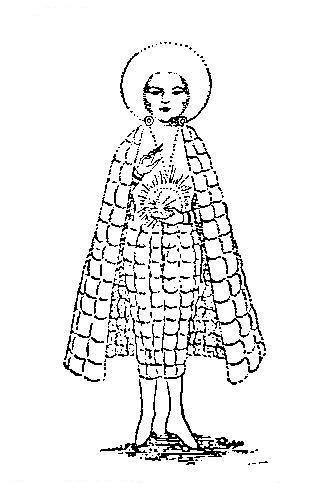
Image of the original apparition (according to the official reports of the Sanctuary of Fatima) produced by Portuguese historians Joaquim Fernandes and Fina D´Armada.

Old and current images of Fatima, whose iconography was “adapted” to the canonical model of Our Lady. Note the difference between the 3 images above and the first, consistent with the report of the seers.

PART II 

“Doc.1
1917–05-c.27, Fatima.

Father Manuel Marques Ferreira, parish priest of Fatima, interrogatory with Lucia de Jesus Santos about the first apparition.

A- First redaction lost.

B-AEL, “Documents of Fatima”, K-2: Notes, pages 11–11v (copy of Fr. José Ferreira de Lacerda, presumably transcribed on October 19, 1917, during the interrogation to the seers).

[11] Interrogation by the parish priest of Fatima Manuel Marques Ferreira with the children who claim to have seen Our Lady.

1st Apparition- 13–5–1917- Lucia, 11 years old, daughter of António dos Santos - Francisco and Jacinta, sons of Manuel Pedro Marto d'Ajustrel. (note: the fourth seer who later was found and the only one who married, Carolina, is missing).

Lucia said everyone was walking ... and everyone saw a woman. Francisco only saw her when she left. Lucia said that they were all sitting and that the woman appeared standing to the side of Fatima.

1st They saw a lightning bolt, rose and began gathering the sheep to go away in fear, then they saw another lightning bolt, then they saw a woman on top of a bush, dressed in white, white socks in the feet, white skirt, white coat, white cloak, which was on her head, the cloak was not golden and the skirt was all gold, she had a golden cord and earrings. (ps .: earrings in the shape of a bow or a ring, cf. António de Morais Filho, “Great Dictionary of the Portuguese Language”, vol.II) very small, her hands were raised and when she spoke she widened her arms and open hands.

This woman said they shouldn't fear, that she wouldn't hurt them. Lucia asked:
- What is your place?
She said:
-My place is the sky.
-Why are you coming to the world? 
- I come here to tell you to come here every month until complete six months, and after I'll tell you what I want.
- Can you tell me if the war will last too long or if it ends soon?
- I can't tell you until I say what I want.
I asked her if I was going to heaven and she said to me:
- You will.
- And my cousin?
- Also will.
- And my [male] cousin?
- This one will still have to pray his [prayer] beads. 
And after that she shook through the air above.
The other two listened to the questions and answers but didn't ask questions.”

Source: “Documentação Crítica de Fátima. I - Interrogatório aos Videntes - 1917 [Fatima Critical Documentation. I - Interrogation with the Seers]”, 2013.

PS .: In the other books of the series there are more accounts of the description of "Lady". Fernandes and D'Armada studied the sources thoroughly and reconstructed what would be the closest image of the “Lady” seen by the seers.

Fatima Critical DocumentationI - Interrogation with the Seers - 1917 

PART III 

"The project “Fatima Critical Documentation”, the scientific edition of documents related to the events of Cova da Iria, Fatima, in 1917, with the evolution of the Sanctuary in that place, and the expansion of the message, in Portugal and abroad, was already present in the thinking of the bishops of the restored diocese of Leiria, D. José Alvez Correia da Silva (1920–1957) and D. João Pereira Venâncio (1958–1972; +1985).

D. João Venâncio, a year before the fiftieth anniversary of the apparitions (1967), made the decision to undertake a critical history of events, entrusting the task to Fr Joaquim María Alonso, C.M.F. (1913-1981). The project was slow and not without difficulties of various kinds.

The project was interrupted after the death of Fr. Alonso in 1981, it was restarted in 1985 by Archbishop Alberto Cosme do Amaral (1972–1993; +2005), third bishop of Leiria (after 1984, Leiria-Fátima), with the scientific sponsorship of the University of Theology of the Portuguese Catholic University, through the Center for Religious History Studies, and a Scientific Committee, whose members have changed over the years.

The critical edition of the documents began to materialize in August 1992, with the first volume dedicated to “Interrogations with the Seers" (1917–1919). The second volume, published in 1999, was dedicated to the “diocesan canonical process (199201930)”, which culminated on 13 October 1930 with the “Pastoral Letter on the Cult of Our Lady of Fatima” by D. José Alves Correia da Silva, with the aim: “1st. To declare as credible the views of the children in the Cova da Iria, parish of Fatima, of this Diocese, at May 13 to October 1917; 2nd. to officially allow the cult of Our Lady of Fatima ”.

Between 2002 and 2013, three more volumes followed, with the documents in chronological order, corresponding to three periods: “from the apparitions to the diocesan canonical process (1917–1922); from the beginning of the diocesan canonical process to the creation of chaplaincy (1922–1927); from the creation of the chaplaincy to the pastoral letter of D. José (1927–1930) ”, distributed in 12 volumes. Throughout the work, 3,811 documents were edited according to the following types: 25 interrogations, 211 official documents of civil and religious authorities, 1,086 letters, 2,322 press articles, 4 books or booklets, 2 memoirs, 66 testimonies, 62 notes and 33 photos. In all, 8,217 pages.

The Commission of the Centenary of Apparitions requested the Scientific Commission to organize a tome with a selection of the most significant documents from 1917 to 1930. In May 2013, 138 documents and an annex were edited, according to the following typologies: 13 interrogations, 24 official documents, 53 letters, 25 press articles, 1 book, 19 testimonials and 3 notes. In all, 651 pages. From the Portuguese edition, translation into English and Italian is already underway, in order to provide non-Portuguese language researchers with a summary of the edited documentation […] ”

PART IV

I transcribe, in full, 2 posts from Prof. Dr. Joaquim Fernandes (Fernando Pessoa University, Porto), pioneer in the dissemination of Fatima documents, published on his facebook:

1- THE “AIRCRAFT” THAT CARRIED THE “LADY” TO THE IRIA COVE ON 13 SEPTEMBER 1917 (2017)

Enlightening, literal and absolutely overwhelming this testimony. Under the diaphanous cloak of the mythical-religious vocabulary the essential is revealed…

From Barthas' book, “Fatima,” (pp. 130–2) I take the following passage:

“Everyone who saw it had the impression, as two priests mentioned - Manuel do Carmo Góis and Manuel Pereira da Silva - that it was similar to an aircraft that brought the Mother of God to the promised meeting with the little shepherds and it then carried her back to Paradise.

With them was Monsignor João Quaresma, Vicar General of the diocese of Leiria, ecclesiastical authorities appointed by the bishop to be part of the Commission of the Canonical Inquiry, considered it natural and permissible for the Virgin to use a means of transport, as it happens with any mortal…

On September 13, at noon, he wrote:

“There was complete silence.

There was the lisp of prayers.

Suddenly shouts of joy… Voices are heard praising the Virgin. Arms rise to point at anything in the air. “Look, don't you see?…” - “Yes, I see!…” Satisfaction shines in the eyes of those who see.

In the blue sky there was not a cloud. I too look up and peer into the breadth of the sky to see what the other happier eyes, first than me, have beheld.

“There you are looking also!…”

To my great admiration, I clearly and distinctly see a luminous globe moving from east to west, sliding slowly and majestically through space.

It was oval in shape, with the larger side facing down.

Beside me a friend priest looked, too, and was fortunate to enjoy the same unexpected and charming apparition… when suddenly the globe, with its extraordinary light, vanished before our eyes.

Next to us there was a little girl dressed like Lucia and about the same age.

Filled with joy, she kept screaming “I still see… I still see… now it goes down!”

Minutes later, exactly the time the apparitions used to last, the child began again to exclaim pointing to the sky:

"Up there again!" and continued to follow the globe with her eyes until it disappeared towards the sun.

- What do you think about that globe? I asked my friend, who was enthusiastic about how much we had seen.

"That was Our Lady," he answered without hesitation.

It was also my belief. The shepherds contemplated the very Mother of God.

We were granted the grace to see the vehicle that had carried her from the sky to the inhospitable heath of the Aire Mountains.”

Fig. 6 - Object or objects observed on September 13, 1917 by Joel de Deus Magno and Dr. Pereira Gens.

Reconstitution of the light globe observed at Cova da Iria, September 13, 1917. (Claro Fângio, 1982)

2-FATIMA: WHEN THE CATHOLIC CHURCH IGNORES ITS OWN DOCUMENTS… (2016)

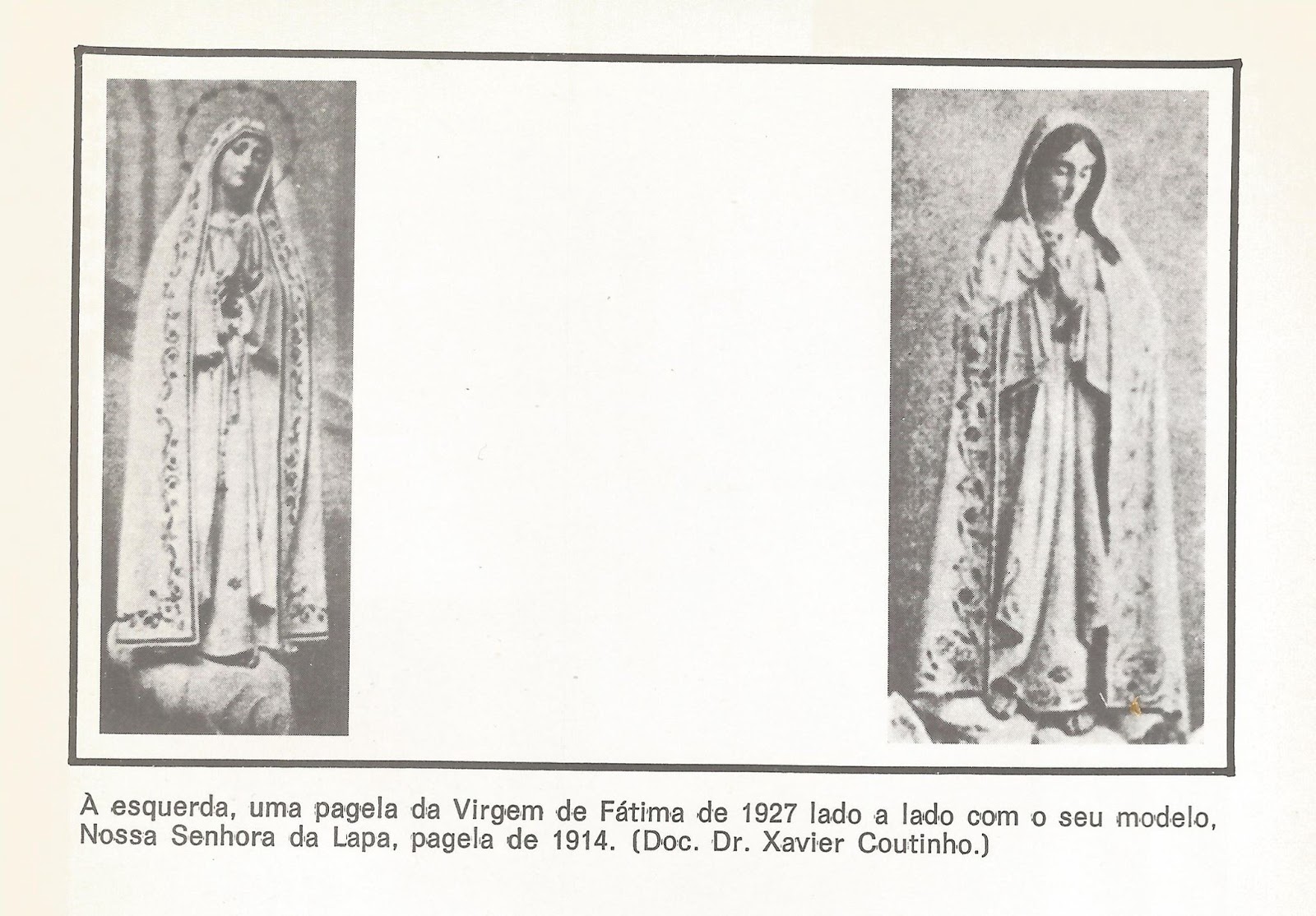
The image worshiped at the Fatima sanctuary, identified as the Virgin Mary described by the shepherds in the apparitions of 1917, is far from being based on the original testimonies recorded in that year's Parish Survey by the parish priest of Fatima, Manuel Marques Ferreira, and contained in the first volume of the Critical Documentation of Fatima (ed.1992). It is important to note the caution of this priest who, month after month, tried to clarify the contours of the alleged visionary experience of the three children. Now, rereading the “portrait” that Lúcia and Jacinta tried to make of the “little woman” that descended on the bush and comparing its morphological details and her objects, one comes to the conclusion without much effort that the traces of the image that intends to reconstruct “ little woman ”of the 13 days omit the general picture of the original descriptions. That is, the current statue of the Virgin Mary, originally conceived by José Ferreira Thedim, exhibited since 1920, in Fatima (the present version is from 1947), and which intended to reproduce the detailed morphology of the alleged celestial entity, has little or nothing to do with the original testimonies contained in the ecclesiastical documents themselves! This official statue, then, results from a calculated gradual “correction” of the accounts to adapt it to the stereotype established after the Council of Ephesus, (431.dC). A study by the authoritative historian of sacred art, Father Xavier Coutinho, professor at Porto's Greater Seminary, clearly assumes that the statue of the Virgin of Fatima has as inspiring model the image of Our Lady of Lapa. In the image, you can see a 1927 Virgin of Fatima compared to a 1914 Our Lady of Lapa. See and compare with the portrait that can be drawn from the original descriptions of Lúcia dos Santos: The unorthodox details of the “little woman”, especially the reference to the “skirt by the knees”, repeatedly mentioned by the seer, would not be in line with the model consecrated on the altars since the high middle ages and in the imaginary of popular piety. Hence the calculated and progressive “deviation” that was introduced into the final definition of the statue: Lucia's “later memories”, acculturated by her Jesuit confessors during her internment in Spain, would eventually naturally yield to the conveniences of religiously correctness and forget the most incongruous details: Thus, the uncomfortable knee-length skirt gradually descended to the feet in literature until it became the Orthodox dress of the Lady…

Following is a summary of the original “portrait” of the “Lady” according to the 1917 Parish Survey:

Nothing prevent that Fatima and her sanctuary can signify a symbolic space for the consecration of a cult of ancient roots, a monument to a millennial generic devotion to the “sacred feminine” of all cultures, with the marked variants. Another thing, different, is to pretend that its statuary, the image venerated there, and identified with the Virgin Mary of Nazareth,  is the faithful portrait of the initial description of the seers. From the point of view of historical criticism, fidelity to documentary and historically documented truth, we think that its not faithful to the original description. 

It is the documents themselves that also show us that the events of Fatima were cataloged in advance before any critical judgment or ecclesial intervention. As in hundreds of other legends of Marian worship in Portugal, the Virgin Mary was necessarily identified beforehand: 

“If the children saw a woman dressed in white, who could it be but Our Lady?” questioned António da Silva, Jacinta's uncle, as soon as the young woman revealed to her mother on May 13, 1917, what she had seen in Cova da Iria. Herein lies the key to all the supposed visions of female entities in all human cultures: for a Jacinta of Celtic civilization the “lady in white” would be Belisama, in ancient Greece would be Aphrodite and the ancient Incas of Bolivia they would call her Orejona. In rural Portugal of 1917, the “little woman” could only be the Virgin Mary. In the midst of the apparitions of 1917 already circulated between the believers the image of Our Lady! It is the cultural “truth” of one's cognitive limits and possibilities - as pointed out by Josef Ratzinger, the emeritus Pope. The hesitations of the Portuguese Church until the late 1920s were not enough to prevent the consecration of the rumor. For the masses of believers became unnecessary any investigation. The ineffectiveness of science at the time gave the green light to popular religiosity and the Marian interpretation of the alleged visions.

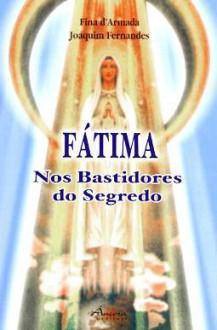
Believers, unbelievers and indifferents can verify and confirm the 1917 “original portrait” of the “Lady”, as well as its evolution over time in our work, with Fina d'Armada, “Fátima nos bastidores do Segredo" [Fatima behind the scenes of the Secret] (ed. Anchor Publisher). Now, for those interested, enjoy the Book Fairs that are announced, starting in Lisbon, where you can still buy this present edition of the work, I suppose few copies will remain…

On the left, a statue of the Virgin of Fatima from 1927, side by side with her model, Our Lady of Lapa, statue of 1914 (Doc. Dr. Xavier Coutinho).


- It was a seemingly feminine figure, very beautiful;
- It was surrounded by a blinding light;
- About 1,10 m [3ft 7.3 in] height;
- Apparently between 12 and 15 years old;
- She was wearing a skirt, a coat, and a cloak, maybe a cover. They were white, but the skirt and cloak had strings of gold. The coat had two to three strings at the cuffs;
- She had something in her head that covered her ears and hair;
- She had black eyes;
- She had a 'prayer beads', a kind of rigs around her neck and a light ball around her waist.
- Came from above and slowly disappeared in reverse direction;
-  Did not perform facial movements or articulate the lower limbs in her locomotion;
-  Spoke without moving her lips;
- Moved only her hands from time to time;
- She turned her back to the seers when he left. 

Fatima behind the scenes of the Secret (ed. Anchor Publisher)
Finally, I share a post by Priscila Garcia, posted on her facebook about the false sister Lucia imposed by Freemasonry:

"Long story, with dire consequences ...

In 1958, shortly after the freemason Roncalli was “elected pope” in an illegitimate process, which involved blackmailing the real elected - Giuseppe Siri, archbishop of Genoa - the freemasons killed the seer of Fatima, Sister Maria Lucia of Jesus and of the Heart Immaculate, who then lived in Carmel Santa Teresa, Coimbra, Portugal.

The seer disappears from the public scene, therefore, only “reappearing” in the 1970s, led by the also freemason, entitled “supreme leader of the Masonic Illuminati”, the heretic Giovanni Baptista Montini, aka Paul VI - in the figure of an IMPOSTOR, placed in her place in a farce made by the same freemasonry, infiltrated in the leadership of the Catholic Church of Rome since the nefarious political operation inaugurated by the mentioned freemason Roncalli and presided by the mentioned freemason Montini, called "Vatican Council II".

In honor of the real Lucia, I post here once again the photographs of her and the impostor that freemasonry has put in her place - for comparison.


Here the freemason Montini “presents” to general scandal the impostor put by the freemasonry in the place of Sister Lucia, the seer of Fatima.


Another comparative photo of the real Lucia and the impostor.


After the real Lucia had been gone for years, surely the masonic leadership considered that her true face would have been forgotten, or would remain just a misty image by the time… And then they finally came up with this, entirely different — and even much younger woman. The photo with Montini is from 1967, the first time the impostor appeared in public. 

Born in 1907, real Lucia would be sixty then - obviously not the age of the impostor, as is clear from the photograph. ”


This article was written by the portuguese researcher Loryel Rocha. The original text can be found here. 

quinta-feira, 22 de agosto de 2019

The Significance of the Distinction between the Essence and Energies of God according to St. Basil the Great (Georgios Martzelos)

Introduction

Concerning the important positions that Professor David Bradshaw has expressed regarding the formation and development of the distinction between essence and energies of God in the Orthodox tradition,1 we think it would be useful, within the limited framework of an article, to offer from a historical and doctrinal view a special discussion of the ontological and epistemological significance of this distinction according to St. Basil the Great. This will clarify his decisive contribution to the development and formation of the above distinction within the Orthodox tradition. As was already emphasized in a related study of ours, it is indeed a noteworthy contribution because Basil was the first of the great Fathers of the Church to develop, not only ontologically, but also epistemologically, this distinction, constituting the basis for its further development, both by the other two Cappadocians, and by the subsequent great Fathers of the Church, especially St. Gregory Palamas.2

The teaching of St. Basil the Great οn the distinction between essence and energies of God is not the outcome of philosophical conjecture, but rather the continuation of the biblical and of the patristic tradition that came before him. Although this teaching was developed in the fourth century by St. Athanasius of Alexandria on an ontological basis and especially in the context of his struggle against the Arians,3 St. Basil further developed it from an ontological and epistemological perspective, in his confrontation with the Eunomians and Pneumatomachians of his age.

1 The Challenge of the Eunomians and the Pneumatomachians

Ιn their attempt to save, from the attack of the Church Fathers, the fundamental Arian teaching that the Son is of different essence than that of the Father, the Eunomians were forced to revise the Arian epistemology and ontology, severing the traditional bond existing between them.

Thus, while the Arians accepted, as did the Fathers of the Church, that created beings are unable to conceive of the uncreated essence of God,4 the Eunomians defended the possibility of full knowledge of the divine essence οn the part of created beings.5 They believed that this knowledge was not the result of any special intellectual effort, but was the consequence of knowledge of the name ‘unbegotten’ (ἀγέννητος), which they accepted as ontologically defining and representing the divine essence.6 Consequently, since the essence of God consisted of his unbegottenness, it could not be ontologically identified with the essence of the Son, which they considered as begotten.7

Based οn the distinction between essence and energies of God, the Eunomians revised the Arian ontology as well. Ιn other words, while the Arians accepted two ontological categories of existence – that of the unbegotten or uncreated for the Father, and the begotten or created for all other beings8 – the Eunomians distinguished ontologically the ‘begotten’ from the ‘created’ and accepted three such categories: the ‘unbegotten’ for the Father, the ‘begotten’ for the Son and the ‘created’ for all remaining creations, among which was included the Holy Spirit. The difference between ‘begotten’ and ‘created’, upon which they distinguished ontologically the Son from the Holy Spirit, resided in the fact that the ‘begotten’ came into being through the energy οf the unbegotten Father, while the ‘created’ came into being through the energy οf the begotten Son.9 Considering the Persons οf the Ηοly Trinity in this manner, as depicting the above-mentioned three ontological categories οf being, they thus excluded their essential relationship.

Οn the basis οf this ontology and epistemology, the Eunomians invented two theological methods with which they sought to prove that the Persons οf the Holy Trinity were οf unlike essence. The first was supported based on the difference between the names ‘unbegotten’ and ‘begotten’, which they attributed respectively to the Father and the Son,10 while the second was supported on the basis of the difference οf their energies, which they accepted as appearing in their ontologically different creations: that οf the Son and the Holy Spirit.11

It is characteristic that these theological methods were used in a different form by the Pneumatomachians, who did not accept the ontology and epistemology of the Eunomians. Ιn other words, in order to prove the createdness of the Holy Spirit, they οn the one hand attributed different prepositions for each Person of the Holy Trinity12 and οn the other hand they maintained that the Holy Spirit did not have creative energy and as such differed in regards to energy from the Father and the Son.13

2 The Ontological and Epistemological Significance οf the Distinction between Essence and Energies οf God according to St. Basil the Great

Against this novel ontology and epistemology as well as the related theological methods οf the Eunomians and the Pneumatomachians, Basil puts forward the ontological and epistemological significance οf the distinction between essence and energies οf God, as well as its definitive importance for the origin and significance οf the divine names.14

According to Basil, the transcendence οf God has not only an οntological dimension but also an epistemological one. In contrast to Eunomius, who considers the ontological transcendence οf God as the presupposition for knowledge οf the divine essence, Basil considers it as the presupposition for not knowing it. For this reason he does not accept the names ‘unbegotten’ and ‘begotten’ as declaring respectively the essence of the Father and the Son, but as declaring the particular manner οf their existence, by which their hypostases are distinguished.15 As with the uncreated essence οf God, likewise the manner οf existence οf his hypostases remains unknown and indescribable. The knowledge οf these is a characteristic property only οf the uncreated Persons οf the Holy Trinity.16 Thus, Basil considers ontology as the foundation οf his epistemology, and he re-establishes their traditional bond, which had been broken by Eunomius.17

For Basil, the emphasis οn the absolute transcendence of the divine essence does nοt run the risk οf agnosticism. While God is in himself completely inaccessible and inconceivable according tο his essence as well as tο his inner-Trinitarian life and movement, he is revealed and made known by his energies, which appear in the creation of the world as well as in the saving economy which surrounds man. As he underlines emphatically, “We say that we know God from His energies; we do not maintain that we access His very essence. And this because His energies come down to us, while His essence remains inaccessible”.18

Ιn other words, God has not only an inner-Trinitarian life consisting of the essential relationship of the three hypostases among themselves, but also an outer-Trinitarian life consisting of the relationship of the divine Persons with the created world through their energies. In this sense, the distinction between essence and energies of God, because of its ontological character is, according tο Basil, valid objectively in God and is not subjective or intellectual, coming from the finite nature of the human intellect, as (mistakenly) the Roman-Catholic theologian E. von Ivánka maintained.19 This is also shown more clearly from the fact that Basil connected this distinction with the distinction between essence and hypostases in a similar manner, so as tο present the absolute correspondence between the eternal and the economic Trinity. Thus, according to Basil, the existence of one essence and three hypostases of God is reflected in the manifestation of the energy and the three particular works of his hypostases.20

Βut the epistemological significance of God’s revelation in the world through his energies is not understood, according tο Basil, independently of man’s relationship and communion with God and participation in His being21. Familiarization with the revelation of God, which He grants through His energies, demands the ethical and spiritual purity of the human mind and its illumination by God.22 Only under these presuppositions can man οn the οne hand know of the existence of God, and of the variety of His energies from Creation23, and οn the other hand know of the unity of essence and the peculiarity οf His hypostases from His saving economy.24

It is in the frame of this epistemological significance of God’s revelation through His energies and of these spiritual presuppositions that Basil gave a very interesting and original answer to the problem of the relationship between faith and knowledge. This problem apparently arose from the discussions between the Eunomians and the Orthodox. The Eunomians, as it is known, in considering the knowledge of the divine essence as the basis of their whole theology25 undervalued the significance of faith for the knowledge of God as set forth by the Orthodox. It appears that for them the knowledge of the divine essence precedes faith in God. And indeed, in their setting forth the primacy of knowledge as over against faith often they would put the question to the Orthodox: “Which came first, knowledge or faith?”26

To this clearly epistemological question Basil responds by taking in view both its theological and its philosophical dimension. Now the answer he gives is not the same for philosophical and theological epistemology.27 For philosophical epistemology faith precedes knowledge. In the first place, one must, for example, believe that element a is called alpha and, having learned the character and its pronunciation, one can subsequently achieve a precise knowledge as respecting its use.28 But in Orthodox theological epistemology the question of the primacy between faith and knowledge is not important, because both the aim and the content of faith is identified with the aim and content of knowledge. In this sense, both the view that faith precedes knowledge and the view that knowledge precedes faith can be regarded as correct. “For if you say of one believing and knowing”, Basil observes characteristically, “of what he believes, of these same things he also knows; or also conversely, of what he knows, these things too he believes”.29 Yet, between these two views Basil inclines most evidently towards the second. From this perspective it appears that he agrees with the Eunomians that knowledge precedes faith. This knowledge, however, has according to him a completely different meaning. It is symmetrical to man’s ability of comprehension and as such it cannot consist of the knowledge of the essence of God but in the knowledge of His existence. And we are led to this knowledge from the energies of God, which are manifested in the creatures that came to be, that were created, by Him.30 As a consequence, when Basil prefers the view that knowledge precedes faith, he means the fundamental knowledge concerning the existence of God. The existence of this elementary knowledge he considers necessary for the development of faith in God. Thus, religious faith is not, according to him, irrational and arbitrary; it is supported upon a rational foundation, which consists of the knowledge of the existence of God derived from the knowledge of creation.31

From another perspective, however, faith, according to Basil, precedes knowledge of God. The knowledge of God cannot be achieved by means of the organs of sense, but by means of the intellect, which is equipped through faith.32 Only through faith is it possible for the necessary pre-requisites of spiritual purity and divine illumination to be realized, for the achievement of the knowledge of God to be rendered possible. Besides, for Basil, faith constitutes the fundamental prerequisite of baptism.33 Through this, sharing in the salvific tradition of the Church, we achieve not only adoption by grace but also knowledge of God.34 And in this sense faith does not constitute simply the pre-requisite of knowledge, just as it is for philosophical epistemology, but is the pre-requisite of the ethical and spiritual life, and only within this framework is true knowledge of God possible.

According to these considerations faith and knowledge are closely connected with each other in a functional unity and constitute two forms of approaching the same thing, insofar as both are supported wholly by and in the energies of God, which are manifested in the world.35 On account of this, no dialectic antithesis subsists between them, something that occurred later during the Middle Ages and the more modern years in the West, when these were considered to be gnostic (cognitive) powers of the human mind functioning independently of the energies of God. If for Basil faith and knowledge are inseparably connected with each other, this is due to the fact that these are not understood independently of man’s relationship with God. And it is precisely for this reason that these are not limited simply to a theoretical conception of the idea of God, but look to a deep existential relationship with Him, which Basil characterizes by the term ‘proskynesis’, veneration or worship. Knowledge, faith and worship constitute for him three stages of the relationship with God which are connected causally between them through the divine energies. Thus knowledge of God does not have as its aim simply and only the basing of faith but also guidance towards His worship.36 Only in worship do faith and knowledge find their theological aim and their deeper meaning and significance.

The above-mentioned ontological and epistemological significance, which Basil attributes tο the distinction between essence and energies of God, is clearly apparent in his teaching οn the origin and significance of the divine names. He maintains that the names attributed tο God come from human conception (ἐπίνοια), which is the unique source of the names of all beings in general. These names, while real, cannot declare the essence of beings but only their various properties.37 Consequently, the names attributed tο God cannot declare the divine essence, as Eunomius maintained, but only the various characteristics of the essence, hypostases and energies of God.38 Thus, ontology, epistemology and teaching οn the divine names are, according tο Basil, interconnected and causally tied together. Ontology is the foundation of his epistemology, and this in turn is the foundation of his teaching οn the divine names. It is exactly for this reason that he was able tο confront the theological methods of the Eunomians and the Pneumatomachians with two contrary but logically unshakable theological methods οf his own, with which he proved the identity οf the essence οf the Persons of the Holy Trinity, invoking either the identity οf their names39 or the identity of their energies.40

Conclusion

Ιn order to fully appreciate the significance οf Saint Basil’s teaching οn essence and energies οf God for the entire Orthodox tradition, we must stress that, with this teaching, he not only responded to the danger which Orthodoxy underwent from the Eunomians and Pneumatomachians, but also contributed decisively tο the development and formulation οf the Τrinitarian doctrine, and especially that of the Holy Spirit. He thus prepared the ground for the theological work οf the Second Ecumenical Council, which was called just two years after his death.

Chiefly, however, Basil, with his teaching οn essence and energies of God, provided the framework for the correct relationship between the uncreated God and the created world, which is the fundamental presupposition for Orthodox Trinitarian doctrine as well as Orthodox Cosmology, Christology and Soteriology. Ιn this way, he provided the necessary presuppositions for the proper manner of confronting not only the Christological question, which had already begun tο preoccupy the theological thought of the Church from his own period, but also the question of man’s real participation in the life of God, which occupied the theological thought of the Church in the fourteenth century. From this point of view, the contribution of St. Basil tο the future development of Orthodox dogma was particularly important.

Ιn particular, Basil put forward the ontological and epistemological significance of the distinction between God’s essence and energies as well as its definitive importance for the origin and significance of the divine names, offering in this way the basis for subsequent development of the teaching οn essence and energies of God within the Orthodox tradition. With the above-mentioned distinction, he indeed provided all the essential theological presuppositions for the connection made later by Palamas, between teaching οn God’s essence and energies and Orthodox spiritual experience and life, consisting in man’s real communion with God and his divinization. Thus, St. Basil was one of the chief contributors to the development of this teaching as the criterion of Orthodox Theology and Spirituality.

From the book: Divine Essence and Divine Energies: Ecumenical Reflections on the Presence of God in Eastern Orthodoxy Paperback 

NOTES

1. See David Bradshaw, Aristotle East and West. Metaphysics and the Division of Christendom (Cambridge, 2004), pp. 154 ff.
2. Cf. Georgios D. Martzelos, Οὐσία καί ἐνέργειαι τοῦ Θεοῦ κατά τόν Μέγαν Βασίλειον. Συμβολή εἰς τήν ἱστορικοδογματικήν διερεύνησιν τῆς περί οὐσίας καί ἐνεργειῶν τοῦ Θεοῦ διδασκαλίας τῆς Ὀρθοδόξου Ἐκκλησίας (Thessaloniki 21993), pp. 25 f; 193.
3. See for example St. Athanasius of Alexandria, De incarnatione Verbi 17, PG 25, 125AB; Adversus Arianos III, 61–4, PG 26, 452A – 460B.
4. According to the witness of St. Athanasius, Arius applied this principle to all created beings, included the Son, underlining this point emphatically with the following words: “Τῷ Υἱῷ ὁ Θεὸς ἄρρητος ὑπάρχει. Ἐστὶ γὰρ ἑαυτῷ ὅ ἐστι, τοῦτ’ ἔστιν ἄλεκτος, ὥστε οὐδὲν τῶν λεγομένων κατά τε κατάληψιν συνίει ἐξειπεῖν ὁ Υἱός. ἀδύνατα γὰρ αὐτῷ τὸν Πατέρα ἐξιχνιάσαι, ὅς ἐστιν ἐφ’ ἑαυτοῦ αὐτὸς γὰρ ὁ Υἱὸς τὴν ἑαυτοῦ οὐσίαν οὐκ οἶδεν. Υἱὸς γὰρ ὢν θελήσει Πατρὸς ὑπῆρξεν ἀληθῶς. Τίς γοῦν λόγος συγχωρεῖ τὸν ἐκ Πατρὸς ὄντα αὐτὸν τὸν γεννήσαντα γνῶναι ἐν καταλήψει; Δῆλον γὰρ ὅτι τὸ ἀρχὴν ἔχον τὸν ἄναρχον ὅς ἐστιν ἐμπερινοῆσαι ἢ ἐμπεριδράξασθαι οὐχ οἷόν τέ ἐστιν” (Epistola de Synodis Arimini in Italia et Seleuciæ in Isauria celebratis 15, PG 26, 708BC). See also Adversus Arianos I, 6, PG 26, 24AB; 9, PG 26, 29B; Ad episcopos Ægypti et Lybiæ epistola encyclica12, PG 25, 565A. Cf. Alexander of Alexandria, Charissimis honoratissimisque ubique ecclesiæ catholicæ comministris 3, PG 18, 573B. About the above-mentioned idea of Arius see G. Zaphiris, ‘Reciprocal Trinitarian Revelation and man’s knowledge of God according to St. Athanasius’, in Τόμος ἑόρτιος χιλιοστῆς ἑξακοσιοστῆς ἐπετείου Μεγάλου Ἀθανασίου (373–1973) (Thessaloniki, 1974), p. 300 f.
5. According to the Church historian Socrates, Eunomius maintained verbatim that man’s knowledge of the divine essence is identified with God’s self-knowledge with the following words: “Ὁ Θεὸς περὶ τῆς ἑαυτοῦ οὐσίας οὐδὲν πλέον ἡμῶν ἐπίσταται. οὐδέ ἐστιν αὕτη μᾶλλον μὲν ἐκείνῳ, ἧττον δὲ ἡμῖν γινωσκομένη. Ἀλλ’ ὅπερ ἂν εἰδείημεν ἡμεῖς περὶ αὐτῆς, τοῦτο πάντως κἀκεῖνος οἶδεν. ὃ δ’ αὖ πάλιν ἐκεῖνος, τοῦτο εὑρήσεις ἀπαραλλάκτως ἐν ἡμῖν”. The same idea had expressed, according to Epiphanius of Salamis, the teacher of Eunomius, Aetius the Anomean: see Panarium 56 (76), 4, PG 42, 521C.
6. See Aetius the Anomean, Syntagmation, in Epiphanius of Salamis, Panarium 11, PG 42, 537C – 541C; Eunomius, Apologia 8, PG 30, 841D – 844B.
7. See Aetius the Anomean, Syntagmation, PG 42, 533C – 545A; Eunomius, Apologia 9–12, PG 30, 844B – 848B; 20–22, PG 30, 856A – 857C. See also Martzelos, Οὐσία καί ἐνέργειαι τοῦ Θεοῦ κατά τόν Μέγαν Βασίλειον, pp. 31 ff. and Bradshaw, Aristotle East and West, p. 156.
8. See Athanasius of Alexandria, Contra Arianos I, 5, PG 26, 21A; 6, PG 26, 24A.
9. See Eunomius, Apologia 15, PG 30, 849C. Cf. Basil of Caesarea, Homilia XXIV, Contra Sabellianos et Arium et Anomoeos 6, PG 31, 612CD. See also Martzelos, Οὐσία καί ἐνέργειαι τοῦ Θεοῦ κατά τόν Μέγαν Βασίλειον, pp. 85 ff.; Georgios D. Martzelos, ‘Der Verstand und seine Grenzen nach dem hl. Basilius dem Grossen’, in Τόμος ἑόρτιος χιλιοστῆς ἐξακοσιοστῆς ἐπετείου Μεγάλου Βασιλείου, pp. 230 f.
10. See Eunomius, Apologia 12, PG 30, 848B; 18, PG 30, 853AB; Aetius the Anomean, Syntagmation, PG 42, 540A. See also Basil the Great, De Spiritu Sancto 4, PG 32, 73AB; Epiphanius of Salamis, Panarium 11, PG 42, 525 A; Theodoret of Cyrus, Historia ecclesiastica 2, 23, PG 82, 1068A.
11. See Eunomius, Apologia 20, PG 30, 856ABC. See also Gregory of Nyssa, Contra Eunomium I, PG 45, 297ABC, 352CD.
12. See Basil the Great, De Spiritu Sancto 4, PG 32, 73A.
13. See Basil the Great, In Psalmum XXXII, 4, PG 29, 333ABC; De Spiritu Sancto 5–6, PG 32, 76A – 77C; 50– 51, PG 32, 160 C; Epistola CXXV, 3, PG 32, 549C. See also W.-D. Hauschild, Die Pneumatomachen. Eine Untersuchung zur Dogmengeschichte des vierten Jahrhunderts (Hamburg, 1967), pp. 46 ff.
14. Martzelos, Οὐσία καί ἐνέργειαι τοῦ Θεοῦ κατά τόν Μέγαν Βασίλειον, pp. 76 ff., 121 ff., 149 ff.
15. See Adversus Eunomium II, 28–29, PG 29, 636C – 640AB. Cf. Bradshaw, Aristotle East and West, p. 158 f.
16. See Adversus Eunomium I, 12–14, PG 29, 540A – 545A; II, 22, PG, 29, 621A; 24, PG 29, 628A; III, 6, PG 29, 668AB; Homilia XXIV, Contra Sabellianos et Arium et Anomœos 7, PG 31, 613C – 616A; In sanctam Christi generationem 1–2, PG 31, 1457 C – 1460 B; Adversus eos qui per calumniam dicunt dici a nobis deos tres 4, PG 31, 1496B.
17. For the break of the traditional bond between ontology and epistemology by Eunomius see Martzelos, Οὐσία καί ἐνέργειαι τοῦ Θεοῦ κατά τόν Μέγαν Βασίλειον, pp. 29 f.
18. Epistola CCXXXIV, 1, PG 32, 869AB: “Ἡμεῖς δέ ἐκ τῶν ἐνεργειῶν γνωρίζειν λέγομεν τόν Θεόν ἡμῶν, τῇ δέ οὐσίᾳ αὐτῇ προσεγγίζειν οὐκ ὑπισχνούμεθα. Αἱ μέν γάρ ἐνέργειαι αὐτοῦ πρός ἡμᾶς καταβαίνουσιν, ἡ δέ οὐσία αὐτοῦ μένει ἀπρόσιτος”.
19. See E. von Ivánka, ‘Palamismus und Vätertradition’, in L’Église et les églises. Études et travaux offerts à Dom Lambert Beaudouin (Chevetogne 1955), vol. 2, pp. 33 ff.; E. von Ivánka, Plato Christianus. Übernahme und Umgestaltung des Platonismus durch die Väter (Einsiedeln, 1964), pp. 429 ff.; E. von Ivánka, ‘Hellenisches im Hesychasmus. Das antinomische der Energienlehre’, in Mélanges patristiques offerts au Cardinal Jean Daniélou (Paris, 1972), p. 495.
20. See St. Basil the Great, De Spiritu Sancto 38, PG 32, 136ABC; see also Martzelos, Οὐσία καί ἐνέργειαι τοῦ Θεοῦ κατά τόν Μέγαν Βασίλειον, pp. 110 ff.
21. As David Bradshaw characteristically notes, “the divine energeiai are not merely operations, but God Himself as manifested within creation. It follows that the sort of participation Basil describes is not merely cooperation with God, but an actual participation in the divine being” (Bradshaw, Aristotle East and West, p. 174).
22. See St. Basil the Great, In Psalmum XXIX, 5, PG 29, 317B; In Psalmum XXXIII, 3, PG 29, 357BC; In martyrem Julittam 7, PG 31, 256A; Epistola CCXXXIII, 1-2, PG 32, 865A – 868B; Adversus Eunomium II, 16, PG 29, 604 AB; De Spiritu Sancto 23 PG 32, 109 AB; 61, PG 32 180 C; see also G. D. Martzelos, Οὐσία καί ἐνέργειαι τοῦ Θεοῦ κατά τόν Μέγαν Βασίλειον, pp. 123 ff.
23. See St. Basil the Great, Adversus Eunomium I, 14, PG 29, 544B; Homilia XII, In principium Proverbiorum 3, PG 31, 392B.
24. See Adversus Eunomium III, 4 PG 29, 661B – 665A; De Spiritu Sancto 19, PG 32, 101C – 104A; 23, PG 32, 109 AB; 37, PG 32, 133CD; 47, PG 32, 153ABC; 64, PG 32, 185 BC. Cf. Epistola CLXXXIX, 6–7, PG 32, 692D – 693C. Especially on this point see Martzelos, Οὐσία καί ἐνέργειαι τοῦ Θεοῦ κατά τόν Μέγαν Βασίλειον, pp. 140 ff.
25. On this point see G. D. Martzelos, Οὐσία καί ἐνέργειαι τοῦ Θεοῦ κατά τόν Μέγαν Βασίλειον, pp. 27 ff.
26. See Basil of Caesarea, Epistola CCXXXV, 1, PG 32, 872A.
27. See C. Bonis, ‘The problem concerning Faith and Knowledge, or Reason and Revelation, as expounded in the letters of St. Basil the Great to Amphilochius of Iconium’, in The Greek Orthodox Theological Review, 5/1 (1959): p. 41 f.
28. See Epistola CCXXXV, 1, PG 32, 872AB.
29. St. Basil the Great, Epistola CCXXXIV, 3, PG 32, 869D – 872A.
30. Epistola CCXXXIV, 1, PG 32, 869 AB; Epistola CCXXXV, 1, PG 32, 872AB.
31. See ibid., PG 32, 872 B; Epistola CCXXXIV, 3, PG 32, 872A.
32. See St. Basil the Great, Homilia in illud ‘Attende tibi ipsi’ 7, PG 31, 216A.
33. See St Basil the Great, Adversus Eunomium 3, PG 29, 665 C; De Spiritu Sancto 28, PG 32, 117BC.
34. See De Spiritu Sancto 26, PG 32, 113AB; cf. ibid., 75, PG 32, 209. See also H. Dörries, De Spiritu Sancto. Der Beitrag des Basilius zum Abschluß des trinitarischen Dogmas (Göttingen, 1956), pp. 133 f.; ‘Basilius und das Dogma vom Heiligen Geist’, in Lutherische Rundschau, 6 (1956–57): pp. 255 f.
35. On the relationship between faith and knowledge according to the Orthodox Theology in general see N. Matsoukas, Γένεσις καί οὐσία τοῦ Ὀρθοδόξου δόγματος (Thessaloniki, 1969), pp. 159 ff.; see also N. Matsoukas, Κόσμος, ἄνθρωπος, κοινωνία κατά τόν Μάξιμο Ὁμολογητή (Athens, 1980), pp. 200, 305 f.
36. See St. Basil the Great, Epistola CCXXXIV, 3, PG 32, 869 C – 872 A; Epistola CCXXXV, 1, PG 32, 872B. See also P. Chrestou, Ὁ Μέγας Βασίλειος. Βίος καί πολιτεία, συγγράμματα, θεολογική σκέψις (Thessaloniki, 1978), p. 243.
37. See Adversus Eunomium I, 6–7, PG 29, 521C – 525C; II, 4, PG 29, 577C – 580B.
38. See St Basil the Great, Adversus Eunomium I, 8, PG 29, 528A – 529 C; II, 5, PG 29, 580C. See also Martzelos, Οὐσία καί ἐνέργειαι τοῦ Θεοῦ κατά τόν Μέγαν Βασίλειον, pp. 158 ff.
39. See St. Basil the Great, Adversus Eunomium II, 24, PG 29, 628C; III, 3–4, PG 29, 661AB; De Spiritu Sancto 11, PG 32, 85A; 48, PG 32, 156C; 53, PG 32, 165D.
40. See St. Basil the Great, Adversus Eunomium III, 4, PG 29, 661 B – 665 A; De Spiritu Sancto 19, PG 32, 101C – 104A ; 53, PG 32, 165D. Cf. Epistola CLXXXIX, 6, PG 32, 692D – 693A.